Choosing between a permanent sheep handling system and a mobile setup often comes down to operational geometry, labour constraints, and transport economics. While central handling hubs excel at high-throughput processing, mobile sheep yards bring the yarding infrastructure directly to pasture, eliminating stock movement stress, biosecurity risks, and unnecessary road transport.
This guide breaks down the practical field logistics, towing requirements, road legality standards, and setup workflows needed to optimise a mobile sheep yarding system.
1. Towing & Trailer Requirements
Operating a mobile yard safely on highway systems and unpaved farm tracks requires matching your tow vehicle to the fully loaded weight of the unit, including all auxiliary gates, drafting race equipment, and onboard tools.
Gross Vehicle Weight Rating (GVWR) & Towing Capacities
Unit Weight Breakdown: Lightweight alloy systems typically range from 750 kg to 1,200 kg. Heavy-duty, fully hydraulic steel yards with integrated drafting races can weigh anywhere from 1,500 kg to over 2,800 kg.
Vehicle Matching: A standard 4×4 utility vehicle or pickup rated for 3.5-tonne towing is ideal for larger systems. Smaller 750 kg unbraked alloy trailers can be towed by lighter agricultural vehicles, provided local regulations permit.
Braking Systems: Trailers over 750 kg Gross Trailer Weight (GTW) must be fitted with operational overrun braking systems or electric trailer brakes.
Off-Road Track Navigation
Ground Clearance: Field entrances, rutted tracks, and soft ground demand high ground clearance and large-diameter flotation tires to prevent bottoming out.
Suspension: Independent torsion axle suspension reduces frame fatigue during transit over rough terrain.
Drawbar Tongue Weight: Ensure proper weight distribution across the trailer axle(s) to maintain a tongue weight of roughly 7%–10% of total trailer weight, preventing dangerous sway on high-speed roads.
2. Road Legality & Compliance
Transporting sheep handling equipment on public roads requires strict adherence to vehicle lighting, width, and licensing regulations.
Lighting & Indicator Boards: Mobile yards with integrated road wheels must feature fully functional tail lights, indicators, brake lights, and high-visibility reflectors. Detachable lighting boards should be tightly secured before entering public roads.
Width & Overhang Restrictions: Most jurisdictions limit overall vehicle and trailer width to 2.55 meters without requiring wide-load permits or escort vehicles. Ensure all folding panels and winch mechanisms are locked pin-secure within the transport frame.
Secure Latching Mechanisms: Relying solely on hydraulics during transit poses a major risk. Always engage mechanical transport safety locks or secondary pin latches before towing.
Driver Licensing: Verify that operators possess the required license class for towing heavy trailer combinations (e.g., BE license categories in the UK/EU or state-specific gross combination mass limits in Australia and North America).
3. Field Deployment Speeds & Setup Workflow
Efficiency is the primary driver for adopting mobile equipment. A well-designed system allows a single operator to transition from highway towing to stock processing in under 20 minutes.
| Phase | Key Tasks | Target Time (1 Operator) |
| 1. Site Selection & Positioning | Position unit on dry, level ground; align mouth of race with natural stock movement direction. | 3–5 Mins |
| 2. Uncoupling & Hydraulic Lowering | Disengage tow vehicle (if necessary), release transport locks, lower chassis via winch or hydraulics. | 3–5 Mins |
| 3. Panel Fanning & Race Assembly | Fan out hurdle/panel packs, connect draft race, secure drop pins, and set outer holding pen perimeter. | 8–12 Mins |
| 4. Pre-Flight Check | Check non-return latches, test draft gate swing, confirm guillotine gate operation. | 2 Mins |
Optimisation Tips for Single-Operator Setup
Capitalise on Natural Flow: Position the entrance gate toward the direction the sheep are already facing or heading. Avoid positioning the exit race straight into blinding direct sunlight or toward dense shadows.
Utilise Terrain Slopes: Where possible, set up the race running slightly uphill. Sheep naturally drift uphill, which improves lead-in flow toward the forcing pen.
Pin & Socket Interlocks: Choose systems with drop-pin or quick-hook panel connections rather than bolt-together systems to minimise setup friction.
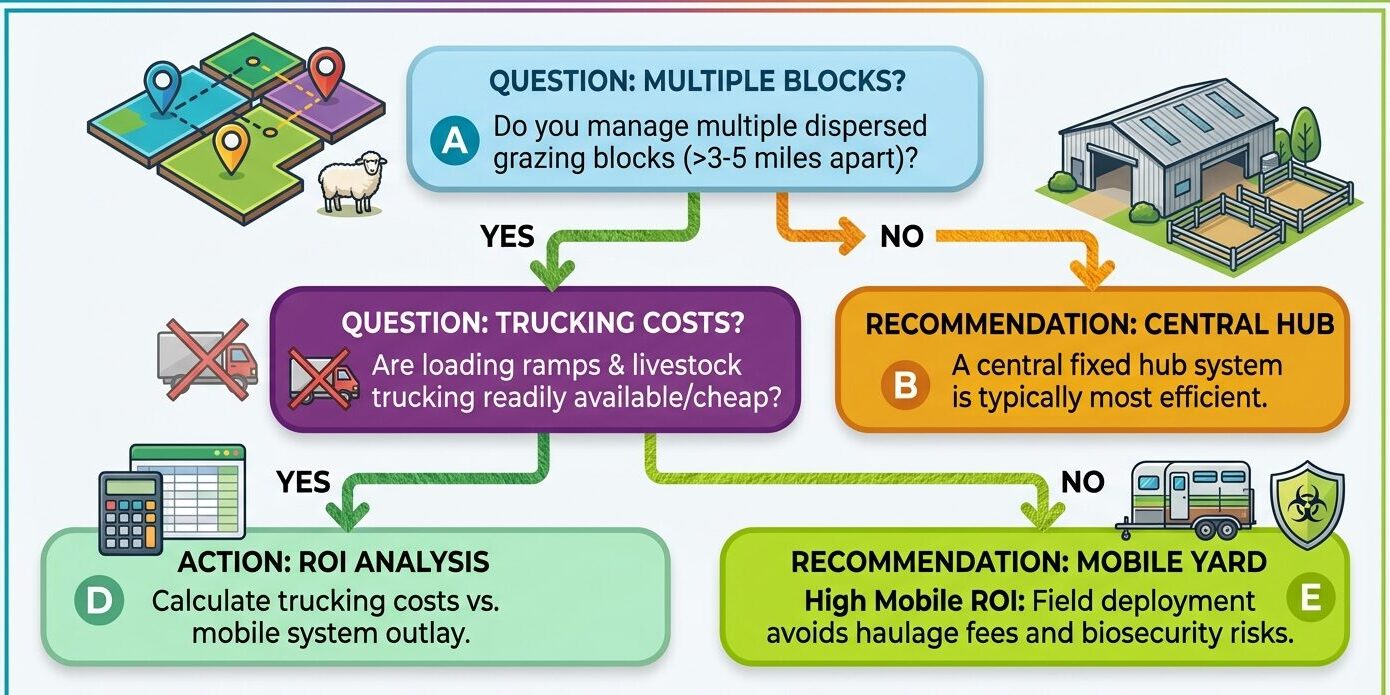
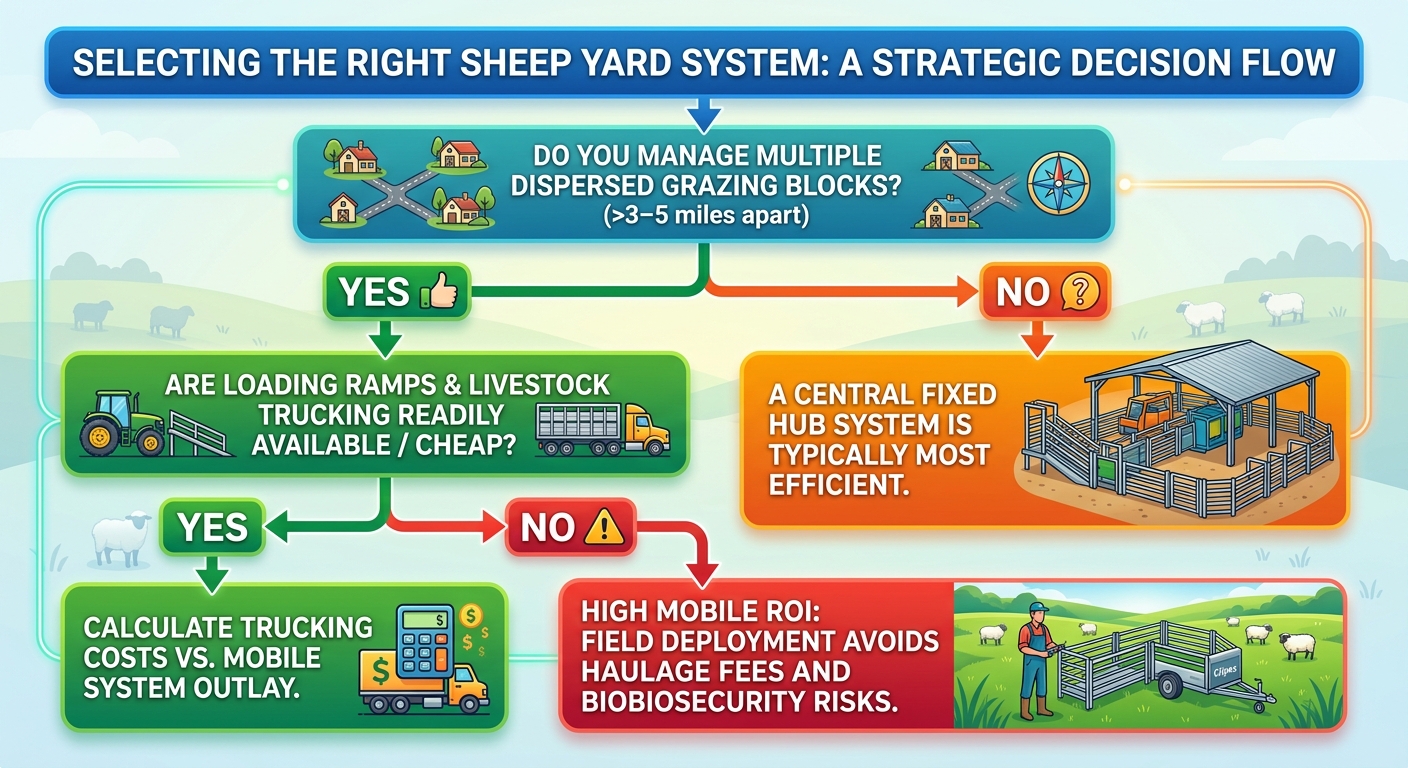
4. Mobile Mobility vs. Central Hub Hauling: Evaluating ROI
Deciding whether to invest in field mobility or transport stock back to a main home hub depends on herd size, pasture fragmentation, and available labour.
Key Advantages of Mobile Systems
Reduced Biosecurity & Disease Vectors: Processing stock on-site eliminates cross-contamination risks associated with mixing groups or running stock through shared central yards.
Lower Animal Stress & Weight Loss: Transporting sheep causes temporary stress and live-weight shrinkage. Treating, drenching, or drafting stock in the pasture preserves condition.
Zero Trucking Overhead: Eliminates the fuel, labour, and machinery costs required to run stock trucks back and forth between out-farms.
Key Advantages of Fixed Home Hubs
Heavy-Duty Capacity: Permanent yards can support integrated weigh crates, automatic drafters, shearing sheds, and concrete flooring for easier cleaning.
Weather Protection: Fixed sheep yards are often built under cover, allowing work to continue during adverse weather.
To evaluate full financial paybacks and labour-saving metrics, explore our detailed breakdown on Mobile vs. Fixed Sheep Yards: Calculating ROI.
Next Steps & Related Resources
Whether you need a compact hurdle trailer for small paddocks or a heavy-duty hydraulic mobile unit for thousands of head, selecting the right setup requires matching design features to your stock numbers.
Read our comprehensive Sheep Yard Buyers Guide for a complete breakdown of panel materials, forcing tub designs, and race dimensions.
Explore Bugle Yards & Circular Forcing Tubs to learn how animal psychology can be integrated into mobile race layouts for effortless single-operator flow.
Complementary Guides for Your System Upgrade:
To further optimize your livestock handling, consider how digital technology impacts your operation. Our Sheep Handler EID Integration Guide details how integrating Electronic Identification (EID) readers and automatic weighing into your new mobile (or fixed) handler can drastically speed up record-keeping and drafting accuracy.
Efficiency isn’t just about mobility; it’s about layout. If you are struggling with bottlenecks in your existing setup, our guide on How to Fix Yard Flow on UK Farms offers practical solutions for identifying and rectifying common flow issues, applying these principles equally to temporary field setups.
If you are leaning toward a more permanent solution or want to build your own fixed infrastructure, review our resource on Sheep Yard Design: How to Build a Safer, Faster Flow. This article focuses on safety metrics and optimal dimensions crucial for high-throughput permanent yards.
Finally, funding is often the critical hurdle. Upgrading your sheep handling capabilities, including mobile systems, is frequently supported by government grants. For the latest application windows and eligible equipment, check our guide on FETF 2026 for Sheep Handling System Upgrades to see how you can offset the capital cost.