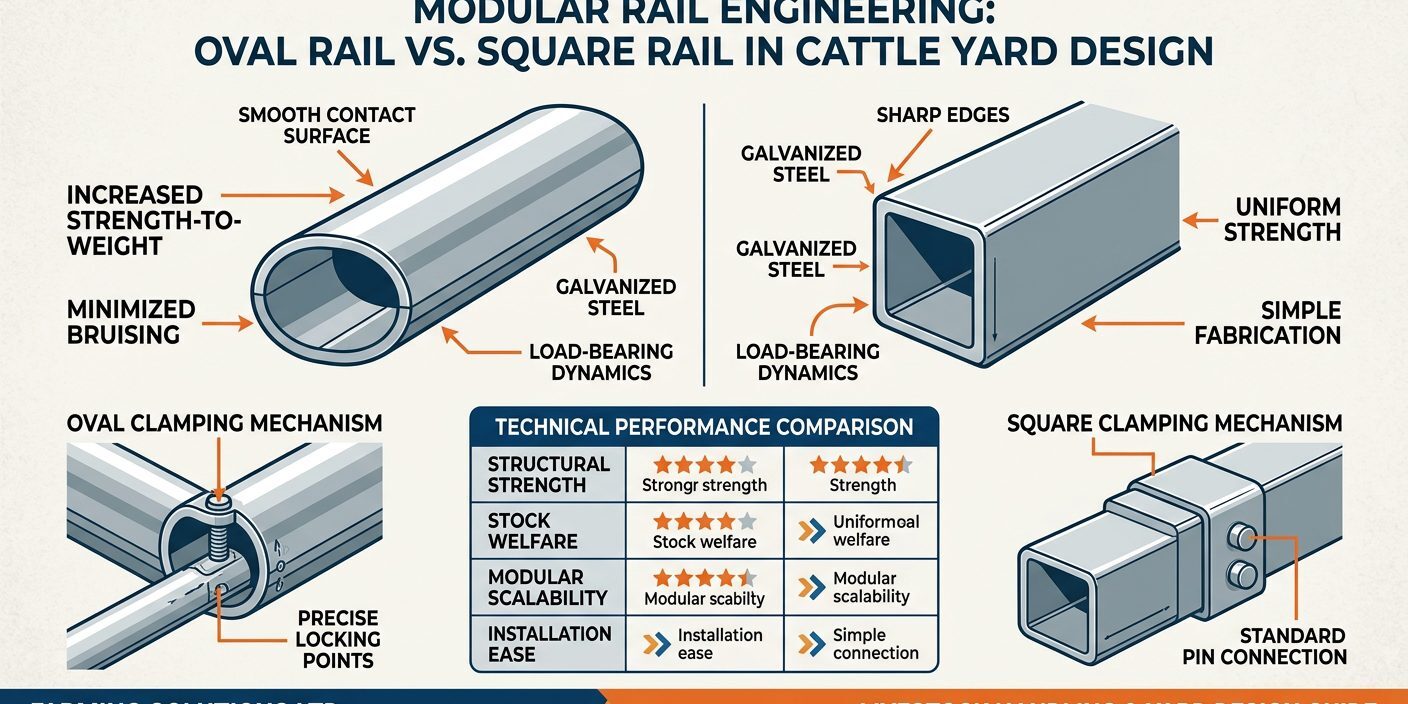
When designing a heavy-duty cattle handling facility, steel frame selection is often oversimplified to wall thickness alone. However, the cross-sectional geometry of the rail profile-specifically Oval Rail vs. Square RHS (Rectangular Hollow Section) vs. Traditional Round Pipe-fundamentally dictates how a handling yard absorbs kinetic energy, protects stock from bruising, and withstands continuous pressure from heavy beef cattle and bull herds.
For high-pressure holding pens, forcing yards, and race sections, modular rail engineering ensures structural longevity without compromising animal welfare or operator safety.
1. Structural Profiles: Oval Rail vs. Square Rail vs. Round Pipe
Understanding mechanical stress distribution across different steel profiles allows livestock producers to choose livestock equipment engineered for high-density impact.
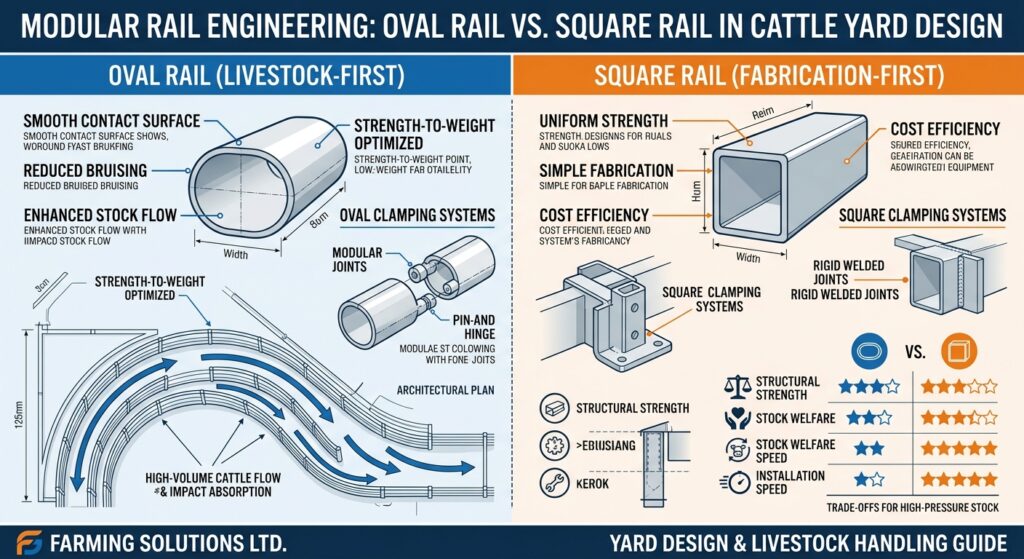
   [ OVAL RAIL ]             [ SQUARE RHS ]            [ ROUND PIPE ]
  ┌──────────────┐          ┌──────────────┐               ┌───┐
 (  Flat Contact  )         │ Sharp Edges  │             (     )  Single Point
  └──────────────┘          └──────────────┘               └───┘   Deflection
 High Surface Area         High Rigidity / Edge         Narrow Contact /
 Zero Animal Bruising        Impact Bruising             Flex Under Load
Oval Rail (Anti-Bruise Geometry)
- Profile: Flat vertical/horizontal face with smooth, continuous radiused edges.
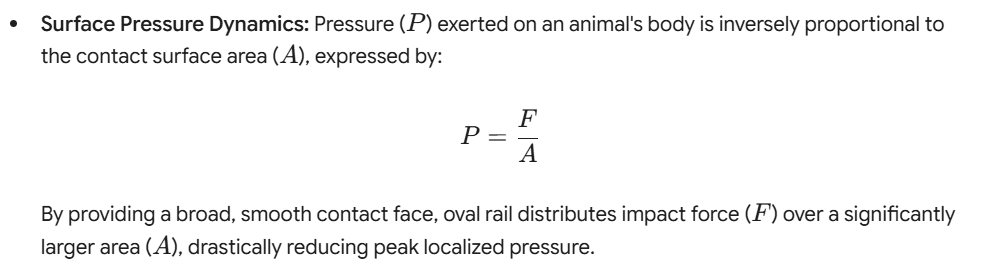
- Stock Safety: Virtually eliminates carcass bruising, hide damage, and rib trauma when flighty cattle rush or lean against panel barriers.
- Sightlines: Offers a lower visual profile from the side, giving animals a clearer forward view through the race while maintaining vertical strength.
Square / Rectangular Hollow Section (RHS)
- Profile: 90-degree corners with flat planar faces.
- Structural Rigidity: Extremely rigid along vertical and horizontal planes with high resistance to bending moments under static loads.
- Stock Drawback: The 90-degree outer edges create localised stress points against cattle flanks and hips. Under high pressure, cattle forced against square rail edges suffer localised tissue bruising and hide marking.
Round Pipe / Tubular Steel
- Profile: Continuous cylindrical cross-section.
- Performance Limits: While economical, standard round pipe provides a narrow tangential line contact area against the animal’s body. Under high lateral pressure from heavy suckler cows or finishing bulls, round pipe exhibits higher elastic deflection and lower resistance to localised denting unless manufactured in high-gauge wall thicknesses.
2. Clamping Systems & Pin Dynamics Under High Load
A modular yard is only as strong as its connection architecture. Under high stock pressure, poorly engineered pin points or lightweight clamps fail long before the main rails bend.
[Panel Rail Section] ──► [Heavy-Duty Sleeve/Lug] ──► [Drop-Pin / Clamp Locking] ──► [Support Post]
High-Tension Drop-Pin Systems
- Application: Ideal for semi-permanent and modular yard configurations where adaptability is required.
- Engineering Requirement: Heavy-walled steel lugs welded directly to the panel uprights, combined with high-tensile solid steel drop pins. Machined tolerances must prevent “slop” or rattle; excess play in pin connections causes progressive metal fatigue and noisy rattling that frightens stock.
Heavy-Duty Clamping Systems
- Application: Essential for fixed and semi-permanent races subjected to continuous lateral impact.
- Engineering Requirement: Dual-bolt wrap-around clamps that grip upright posts across a full 360-degree surface area. Clamping systems allow infinite height adjustments while distributing clamping forces evenly around structural posts without puncturing or weakening post integrity.
3. Load-Bearing Dynamics for High-Pressure Stock
In crowding pens, forcing tubs, and entry races, cattle exert immense lateral forces. Designing for high-pressure stock requires balancing structural yield strength with modular shock absorption.
- Impact Energy Dissipation: When a 800 kg bull hits a panel at speed, kinetic energy ($E_k = \frac{1}{2}mv^2$) must be safely absorbed. Rigidly welded fixed yards transfer $100\%$ of this force directly into ground footings, requiring heavy reinforced concrete slabs. Modular oval rail yards dissipate a fraction of this energy through localised panel flexing and rubber-buffered pin joints.
- Rail Spacing & Height: High-pressure beef pens require a minimum 6-rail panel setup extending $1.60\text{ m}$ to $1.80\text{ m}$ high, with tighter rail spacing at the bottom to prevent calves or youngstock from trapping legs or heads.
Further Reading in Livestock Handling & Yard Design
Building a safe, high-throughput handling facility requires balancing animal behaviour, structural engineering, and digital technology. Explore our complete guide archives across the Livestock Handling & Yard Design category for detailed breakdowns on yard layouts, grant eligibility, and single-operator safety.
Yard Layout & System Design
- How to Design a Safe and Efficient Cattle Handling System
- Designing Handling Systems for One-Person Operation
- Designing a Handling System for Mixed Beef and Dairy Enterprises
- Calf Pen Design: The Ultimate Guide to Safer, Low-Stress Care
Cattle Crushes & Solo-Operator Safety
- Cattle Crush Selection for UK Farms: Integration That Works
- The Best Equipment for Handling Cattle Alone
- How to Handle Large, Strong, or Aggressive Cattle Safely
- The True Cost of Poor Handling Equipment and How to Avoid It
EID Tech, Grants & Economics
- How to Integrate EID Readers into Your Cattle Handling System
- Preparing for the New Era: A Guide to Cattle EID in England (2027)
- FETF 2026 for Cattle Handling System Upgrades
- FETF60 & FETF61 Cattle Crush Grants: Engineering & Safety
Animal Flow, Labor & TB Biosecurity
- Improving Cattle Flow: Behavior-Based Handling Tips
- How to Reduce Labour in Livestock Handling
- The Role of Handling Systems in TB Control
- Practical Ways to Reduce TB Risk in Cattle Handling Areas
- How Youngstock Management Reduces TB Transmission Risk
Engineer Your Yard for Zero Bruising & Maximum Strength
Upgrading your yard infrastructure starts with selecting the right rail profile and clamping architecture for your stock type. Contact Farming Solutions Ltd for tailored livestock handling advice, yard layout design, and high-specification livestock handling equipment, such as cattle crushes, sheep handlers, and EID Solutions.
- Phone: 07890 325264
- Email: alan@farmingsolutionsltd.com