
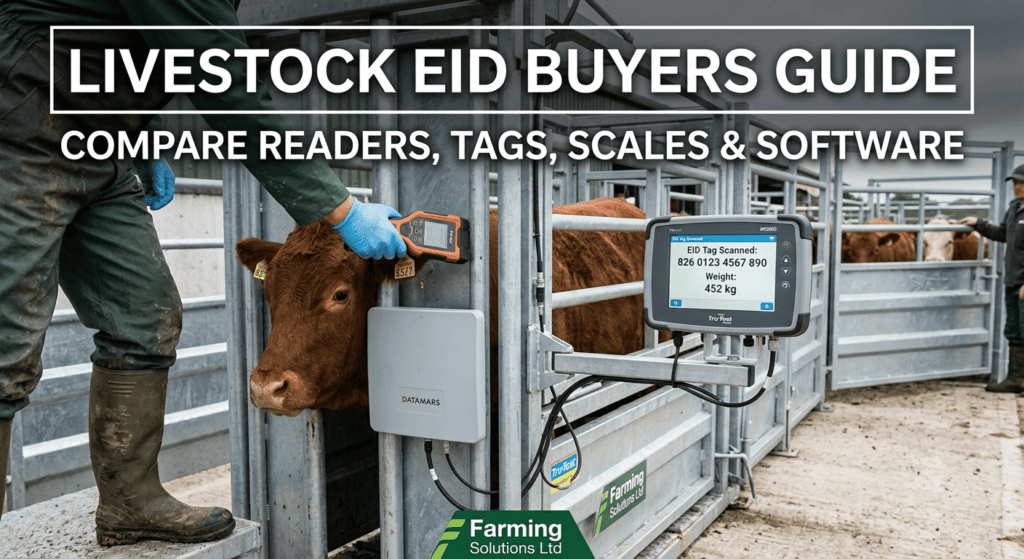
Livestock EID Buyers Guide
Livestock EID Buyers Guide – Investing in electronic identification (EID) hardware is one of the most impactful decisions you can make for your livestock enterprise. Whether you are preparing your yards for compliance, streamlining routine livestock handling days, or looking to capture accurate liveweight data for better growth performance, moving from manual paperwork to digital tracking transforms how your farm operates.
However, with a wide array of tags, stick readers, panel antennae, weighing indicators, and software platforms on the market, choosing the right EID system can feel overwhelming.
This Livestock EID Buyers Guide cuts through the noise, breaking down everything UK farmers need to know to spec, budget, and install a reliable, future-proof EID setup.
1. Understanding the Regulatory Landscape: Why EID is Essential
Electronic identification is no longer just a luxury for forward-thinking farms, it is rapidly becoming a legal requirement across the UK livestock sector.
The 2027 Cattle EID Mandate: With the UK transitioning towards stricter traceability, newborn calves in England face upcoming mandates requiring electronic tagging. Preparing your infrastructure now prevents last-minute bottlenecks.
Flock Traceability: Sheep EID has been mandatory for years, but upgrading how you capture those tag numbers in your sheep handling system unlocks massive labour savings.
Read our full background and timeline guides:
2. Starting at the Ear: Choosing EID Tags (FDX vs. HDX)
The foundation of any reliable data capture system starts right at the animal’s ear. Understanding how low-frequency (LF, 134.2 kHz) tags communicate with your EID readers helps prevent missed scans in the yard.
FDX-B (Full Duplex): Cost-effective, widely used, and highly reliable for standard handling where animals pass at a steady pace close to the reader.
HDX (Half Duplex): Offers a stronger signal and a larger reading zone, making it an exceptional choice for high-throughput panel reader setups in fast-moving races.
Read the full breakdown: Understanding EID Tags: FDX, HDX, and Choosing the Right Technology
3. Selecting Your Hardware: Stick Readers vs. Panel Readers
Once your stock is tagged, you need the right data capture tool to log them efficiently without causing animal stress or worker fatigue.
Handheld EID Stick Readers: Lightweight and completely mobile. Ideal for field checks, loose housing, smaller mixed herds, and low-to-medium throughput tasks.
Fixed Panel Readers: Stationary antennae mounted directly onto your cattle crush race or sheep handler. They automate data capture entirely as stock pass through, making them essential for commercial-scale operations.
Read the full comparison: Stick Readers vs. Panel Readers: Choosing the Right Data Capture Tool
4. Hardware & Handling Differences: Cattle vs. Sheep Setups
The core goals of EID are identical across species-speed and compliance-but the physical handling requirements are vastly different.
Cattle Setups: Focus on heavy-duty crush integration, safe operator zones, and precise stick or panel reader positioning to combat dense steel interference.
Sheep Setups: Focus on high-speed drafting modules, weigh crates, and automated sorting gates.
Read our specialised setup guides:
5. Building the Complete Data Workflow: Scales, Readers & Software
A standalone reader or a set of loadbars is only half the battle. True efficiency comes when your equipment connects into a seamless digital loop:
Capture: Readers and loadbars log ID and weight simultaneously.
Process: Weigh scale indicators (like Tru-Test series units) act as the yard-side brain, matching IDs to live weights.
Manage: Cloud farm software syncs your data for movement reporting, medicine tracking, and growth performance monitoring.
Read the full integration guides:
6. Upgrading Your Yard Layout & Funding Your Investment
Electronic hardware only performs at its best when supported by a well-designed livestock handling system that works with natural livestock behaviour. Furthermore, capital grants can significantly offset your upgrade costs.
Yard Flow & FETF Grants: Ensure your races feature curved approaches, solid-sided panels, non-slip flooring, and grant-approved layouts. Pair your EID setup with a heavy-duty crush or handling system.
Explore related guides and master resources:
Cattle Crush Buyers Guide: How to Choose the Right System for Your Farm
Retrofitting Livestock Handling System Layouts for FETF Grants