
Mobile vs. Semi-Permanent Sheep Yard Systems: The Ultimate Buyers Guide
By: Technical Engineering Team & Alan Hughes
Published: Farming Solutions Ltd
Category: Sheep Handling & Yard Design | Part of our Buyers Guides Hub
Efficient sheep management requires sheep handling equipment that works with your farm’s topology, land tenure, and labour availability. Whether running ewes across disparate outlying grazing blocks or managing a high-density, centralised flock at a main home yard, choosing between Mobile Trailing Systems and Semi-Permanent Yard Systems (such as the Clipex S400 and Clipex S650) is one of the most critical capital decisions on a sheep farm.
This comprehensive Mobile vs. Semi-Permanent Sheep Yard Systems Buyers Guide evaluates flock-size metrics, labour dynamics, transportability trade-offs, and single-operator efficiency to help UK sheep farmers choose the right sheep handling system for maximum throughput and seamless EID auto-drafting integration.
1. Introduction: Matching Infrastructure to Enterprise Scale
Modern sheep enterprises face rising labour costs, limited skilled help, and increasing demands for precise individual animal data. Upgrading your sheep yard isn’t just about buying steel gates; it’s about engineering an environment that works with natural flock instincts.
Every high-performance sheep handling facility must achieve three baseline goals:
Maximise Animal Flow & Welfare: Harness natural behavioural instincts to eliminate baulking, stress, and flock backflow (as detailed in our guide to Fixing Yard Flow on UK Farms, Sheep Yard Design: How to Build a Safer, Faster Flow).
Minimise Labour Requirements: Enable safe, high-throughput, single-operator sheep handling.
Integrate Precision Tech: Provide modular mounting for heavy-duty loadbars, EID stick/panel readers, and automated 3-way or 5-way drafting gates, fully covered in our Livestock EID Buyers Guide and Sheep Handler Buyers Guide.
2. Flock Size Metrics & Equipment Capacity Thresholds
Selecting the correct yard footprint prevents severe handling bottlenecks while avoiding unnecessary capital expenditure. Matching your yard capacity to ewe numbers is essential for maintaining smooth processing speeds.
| Flock Scale | Recommended System Type | Model Benchmark | Operational Characteristics | Key Equipment Focus |
| Under 250 Ewes | Mobile Trailing Unit / Modular Hurdles | Portable Mobile Yard / Compact S400 | Multi-site grazing, temporary setup, rapid setup/teardown. | Light sheeted hurdles, 3-way manual drafting gate, compact race. |
| 250 – 600 Ewes | Versatile Semi-Permanent or Heavy-Duty Mobile | Clipex S400 Semi-Permanent Yard | Balanced needs: high holding capacity (up to 400 sheep) across 4 contained zones (~189 m²). | Integrated V-race, 3-way draft module, anti-backing gates. |
| 600+ Ewes | High-Capacity Semi-Permanent Installation | Clipex S650 Semi-Permanent Yard | Hub-and-spoke farming, centralized handling (up to 650 sheep) across 6 contained zones (~263 m²). | Straight drenching race, permanent sheep rail, auto-drafter & EID integration. |
3. Labour Efficiency & Single-Operator Flow Dynamics
With solo shepherd operations becoming the industry standard, yard geometry directly dictates physical workload.
Core Design Elements for Solo Shepherds
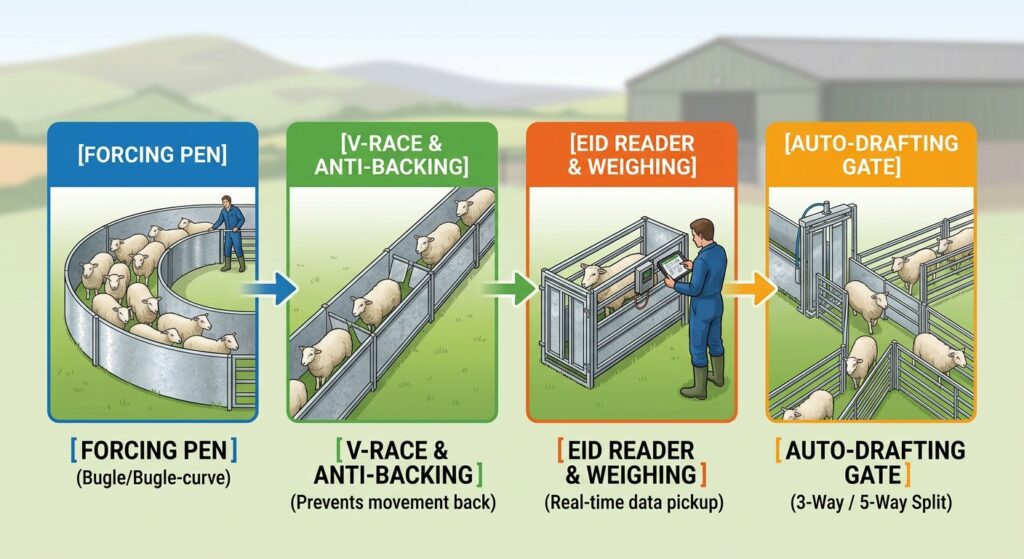
Circular / Curved Forcing Tubs: Sheep naturally move toward where they entered and follow curved outer walls. Circular bugle forcing pens eliminate corners where stock jam or stack up, allowing one operator to keep the race continuously primed without dog pressure. Bugle Yards & Circular Forcing Tub Design for Sheep
Sheeted Hurdles & Blind Spots: External visual distractions cause sheep to baulk. Full-height sheeted hurdles stop sheep from spotting handlers, dogs, or vehicles, forcing their line of sight straight down the race toward open gates or decoy sheep.
Tapered V-Races & Anti-Backing Flaps: Tapered V-bottom races prevent small lambs or adult ewes from turning around or riding up on each other. Overhead or side-mounted anti-backing gravity flaps allow smooth forward progress while mechanically locking out rearward movement.
Auto-Drafting & EID Integration: Connecting high-performance EID panel readers to pneumatic auto-drafting gates (e.g., Clipex 6-in-1 auto-drafter or the automatic sheep handler) enables one person to weigh, log data, and split up to 800 head per hour into 3 or 5 sorting streams completely hands-free.
Ground Preparation & Pad Layout for Semi-Permanent Sheep Yards
Mobile Sheep Yards: Towing, Setup Times & Field Logistics
Sheep Handler EID Integration: Connecting Scales, Readers, and Software
4. Transportability vs. Throughput: Evaluating Trade-Offs
| Feature | Mobile Trailing Yards | Semi-Permanent Systems (S400 / S650) |
| Field Mobility | High – Towable behind 4×4 or tractor; deployment in 15–30 mins. | Moderate/Low – Designed for fixed location or seasonal relocation via trailer. |
| Ground Stability | Dependent on terrain, pegs, and field surface conditions. | High – Fixed posts, extended footplates, and pin anchors ensure structural stability. (See our Ground Preparation Guide). |
| Holding Capacity | Typically 100–250 head per setup without extra hurdles. | 400 to 650+ head contained across multiple multi-way pens. |
| Automation Integration | Basic weighing; automated crate mounting can be restricted by road width/weight limits. | Seamless – Built-in mounting for heavy-duty pneumatic handlers, weigh bars, panel readers, and auto-drafters. |
| Biosecurity Advantage | High – Allows on-site treatment across isolated grazing blocks without stock movement. | Controlled – Best suited as a central biosecurity processing center for incoming stock or quarantine. |
5. Decision Matrix & Buyer Checklist
Before committing capital to a new system, review this decision checklist:
[ ] Land Ownership & Tenancy: Do you farm on short-term seasonal lets (favouring Mobile or relocatable S400 setups) or an owned/long-term central hub (favouring the high-capacity S650)?
[ ] Flock Dispersion: Are ewes spread across outlying blocks without interconnecting droving corridors, or can stock be driven directly back to a central handling point?
[ ] Primary Operational Tasks: Is usage focused on quick field-side dosing/flystrike spot checks (where mobile trailing units excel), or intensive multi-way drafting, condition scoring, EID recording, and foot care (where an S650 semi-permanent yard excels)?
[ ] Grant Funding Eligibility: Does your chosen system meet current statutory grant standards? Explore our FETF Grants for Sheep Handling Systems Guide to verify item codes and funding rates.
Mobile vs. Fixed Sheep Yards: Calculating the ROI of Automated Handling
How to Choose the Right Sheep Handler for Your Flock Size
Sheep Handlers vs Auto Drafters
Clipex Sheep Handler Comparison
Explore Our Full Suite of Agricultural Buyers Guides
Looking to upgrade cattle or biosecurity facilities alongside your sheep yard?
Browse our dedicated engineering guides:
Ready to Design Your Custom Yard Layout?
Designing a handling system that satisfies grant specifications, maximises throughput, and suits your exact farm footprint can be complex. Whether you need a compact mobile setup or a bespoke 650-head semi-permanent hub, Alan Hughes and the technical engineering team at Farming Solutions Ltd are here to help.
Contact Farming Solutions Today to request a custom yard design consultation, discuss equipment compatibility, or prepare your next grant funding application.